The Em Dash: Casualty of the AI Revolution
Once upon a time, the em dash was the cool punctuation mark. It was the leather jacket of grammar—slightly rebellious, effortlessly stylish, and beloved by writers who wanted to add a little swagger to their sentences.
It used to be a writer’s secret weapon—an elegant pause, a way to pivot mid‑thought without the stiffness of a semicolon or the clutter of parentheses. It was versatile, expressive, and favored by essayists, novelists, and journalists alike.
Then came AI. And like a freshman who just discovered Hemingway, it started throwing em dashes around like confetti. Every pause? Em dash. Every aside? Em dash. Every sentence that couldn’t quite figure out where it was going? You guessed it—em dash.
Now, the poor em dash has a reputation problem. Editors see it and mutter, “Ugh, this looks like AI.” Writers, terrified of being mistaken for bots, retreat to commas and semicolons, leaving the em dash abandoned in the corner like yesterday’s meme. And the publishing companies demand its extinction—because apparently, readers will only find the material believable if it’s stripped of the em dash entirely. As if punctuation itself were guilty of fraud.
That perception is unfair. The em dash wasn’t invented by AI—it’s been part of the writer’s toolkit for centuries. To abandon it now is to let algorithms dictate our style. Real writers shouldn’t shy away from the em dash simply because software overuses it. Instead, we should reclaim it, reminding readers that punctuation is about rhythm and voice, not about whether a bot likes to overdo it.
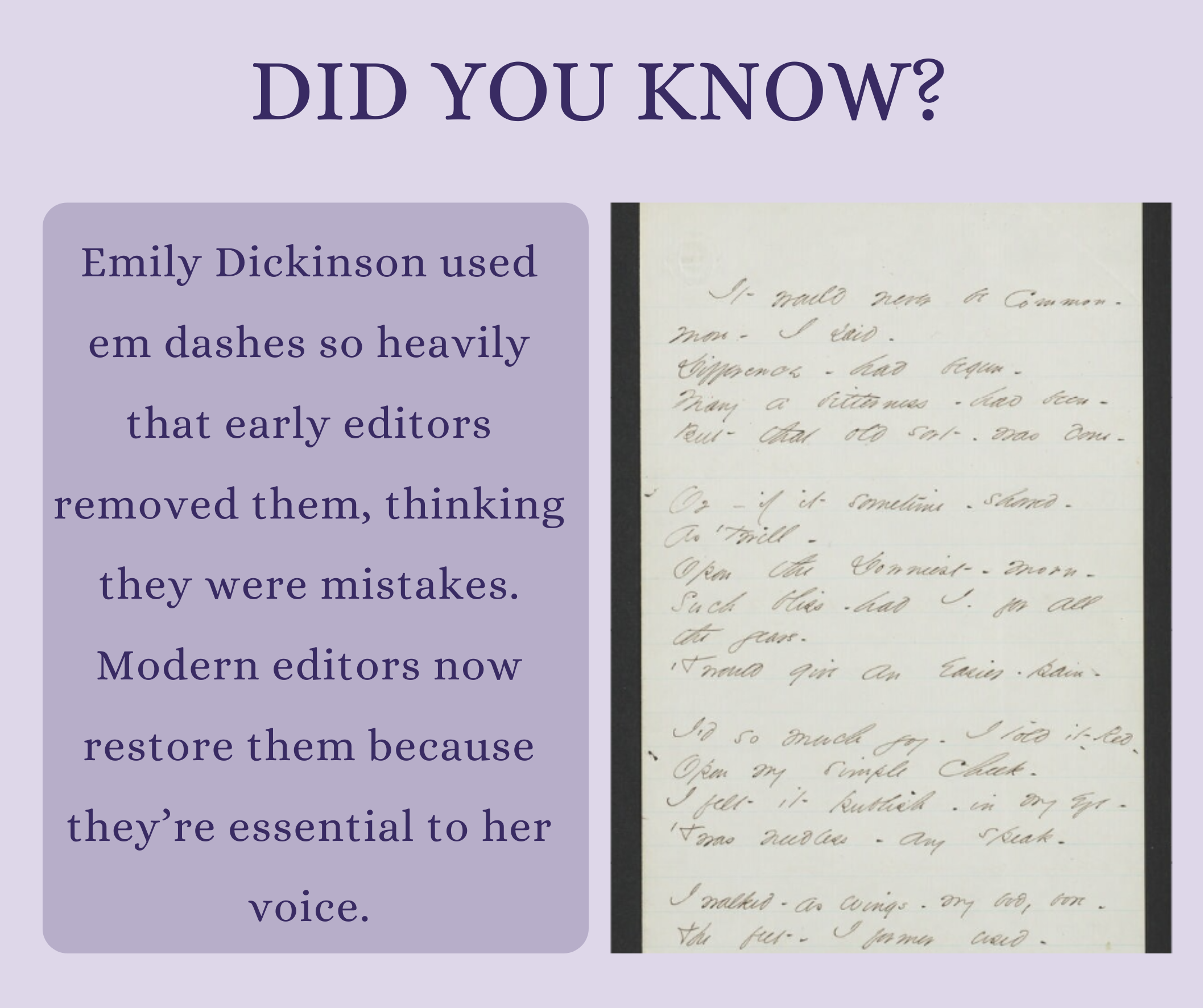
Manuscript image courtesy of the Emily Dickinson Archive (public domain).
To look at a piece of punctuation and automatically flag it as fake is as misguided as trusting those so‑called AI checkers to determine whether writing is machine‑generated. They don’t work. And yet, here we are, treating the em dash like contraband because an algorithm got carried away with it.
But here’s the truth: The em dash didn’t die—it was murdered by overuse. And blaming the punctuation mark itself is like blaming the spoon for bad soup. Real writers know the em dash is still a powerful tool when used with restraint.
So let’s stop the witch hunt and quit pretending the em dash is radioactive. AI may have cheapened it, but it’s ours to reclaim. After all, punctuation is about rhythm and voice—and nothing says “human” quite like knowing when to stop leaning on the em dash and let it breathe.
And yes, I leaned on the em dash—hard. But that’s not AI talking; that’s me reminding you it still belongs to us. So grab your leather jacket, dust off your swagger, and don’t be afraid to reach for the em dash. It’s not a machine’s crutch—it’s a writer’s weapon. Use it boldly, use it wisely, and let it remind the world that style still belongs to humans.
Curious about the em dash? I posted a quick, quirky breakdown on Facebook—you can find it here.